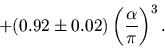
One day, terror struck; early spring of 1975 I was invited to Caltech to give a talk.
I could go to any other place and say that Kinoshita and I have computed
thousands of diagrams and that the answer is, well, the answer is:
Now, you probably do not know how stupid the quantum field theory is in practice. What is done (or at least was done, before the field theorists left this planet for pastures beyond the Planck length) is:
 to
to  was a typical range
And indeed; when the diagrams that we had computed were grouped into
gauge invariant subsets, a rather surprising thing happens; while the
finite part of each Feynman diagram is of order of 10 to 100, every subset
adds up to approximately




I prepared the talk for Feynman, but was fated to arrive from SLAC to Caltech
precisely five
days after the discovery of the  particle. I had to give an
impromptu irrelevant talk about what would the total
particle. I had to give an
impromptu irrelevant talk about what would the total  cross-section had looked
like if were a heavy vector boson, and had only 5 minutes for my
conjecture about the finiteness of gauge theories.
Feynman liked it
and gave me some sage advice.
cross-section had looked
like if were a heavy vector boson, and had only 5 minutes for my
conjecture about the finiteness of gauge theories.
Feynman liked it
and gave me some sage advice.
The eighth order contribution to the electron g - 2
from diagrams without any fermion loop is
-1.9344(1370) as of 1990 (in my book on QED).
So, unfortunately, it appears that it does not
conform to your pet theory.
Aoyama, Hayakawa, Kinoshita, and Nio (Jul 2012) heroic calculation has progressed to the tenth order. They use the self-energy method for evaluating (g-2), described in the Cvitanović and Kinoshita tryptich of sixth-order papers, so they are not able to separate out the minimal gauge sets that I use to argue that the mass-shell QED is convergent. They report for the “quenched” set (no lepton loops, only virtual photons):
A(8)1,V ≈ -2 , while my guess based on 6 gauge sets would be A(8)1,V = 0, which is pretty darn close, considering this is a sum of 518 diagrams and a zillion counterterms.
A(10)1,V ≈ 10, while I predict, based on 9 gauge sets, that A(10)1,V = 3/2, which is extremely good for a sum of 6,354 diagrams! Even the sign comes out right :)
Suppose each diagram contributed ≈ ± 1 (actual numbers are more like ≈ ± 100) and they were statistically uncorrelated. Then one would estimate A(10)1,V ≈ ± 80. Cancelations that lead to A(10)1,V ≈ 10 are amazing.
Of course, asymptotic series can be very good, and all of this is a wild guesswork
and means nothing until there is a method to estimate these
sums. One thing that would make the finitness conjecture
more convincing would be to check how close individual gauge sets
are to ± 1/2, but I do not think that data is available - does anyone evaluate
individual vertex diagrams, rather than the self-energy diagrams?
I've now reread all the relevant literature, and see several ways ways forward. It is a longer story, for an overview, please see my blog.