 |
|
This research is supported by NASA's Fluid Physics Program
|
Control of Spatially Extended Systems
The desire to improve performance of many practically important systems and
devices (semiconductor lasers, chemical reactors, internal combustion engines,
etc.) often calls for shifting their operating range into a highly nonlinear
regime, which after a series of bifurcations typically leads to irregular
chaotic behavior. This side effect is usually undesirable, while substantial
benefits could be obtained by making the dynamics regular (e.g., by creating
patterns). This goal can be achieved by applying feedback to steer the system
towards a state with desired properties, which is broadly referred to as chaos
control. Numerous experiments suggest that spatially extended systems present
additional difficulties. It turns out that that the primary reason for these
difficulties is rooted in the geometry: spatial uniformity and isotropy cause
degeneracies in the spectrum of the evolution operator, leading to failure of
conventional control techniques. Efficient control algorithms applicable to
experimental extended systems are the subject of my group's current
research.
Most of our research in this area is directed at control of instabilities
arising in fluid systems. One particular example is the contact line
instability in spreading thin liquid films driven by a thermally imposed
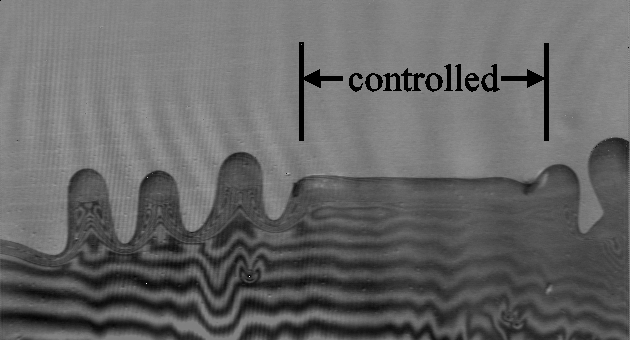
gradient is surface tension. In the figure below (click here to see
a movie) the liquid spreads in the upward direction and undergoes a
fingering instability without control. As the images shows, applying feedback
effectively quenches the instability. The left (uncontrolled) half of the
contact line develops "fingers", while the right (controlled) half remains
straight. In the experiments control is applied by radiatively heating or
cooling the capillary ridge behind the contact line by an amount proportional
to the local deviation of the contact line from the mean position.
 |
| Experiment by M. Schatz |
-
N. Garnier, R.O. Grigoriev, and M.F. Schatz,
Optical manipulation of microscale fluid flow,
Phys. Rev. Lett. 91, 054501 (2003)
[PDF]
-
R.O. Grigoriev,
Contact line instability and pattern selection in thermally driven liquid
films, Phys. Fluids 15, pp. 1363-1374 (2003)
[PDF]
-
R.O. Grigoriev,
Control of evaporatively driven instabilities of thin liquid films,
Physics of Fluids 14(6) pp.1895-1909 (2002)
-
R.O. Grigoriev,
Symmetry and control: spatially extended chaotic systems,
Physica D 140(3-4) pp. 171-193 (2000)
-
R.O. Grigoriev, M.C. Cross, H.G. Schuster,
Pinning control of spatiotemporal chaos,
Phys. Rev. Lett. 79(15), pp. 2795-2798 (1997)