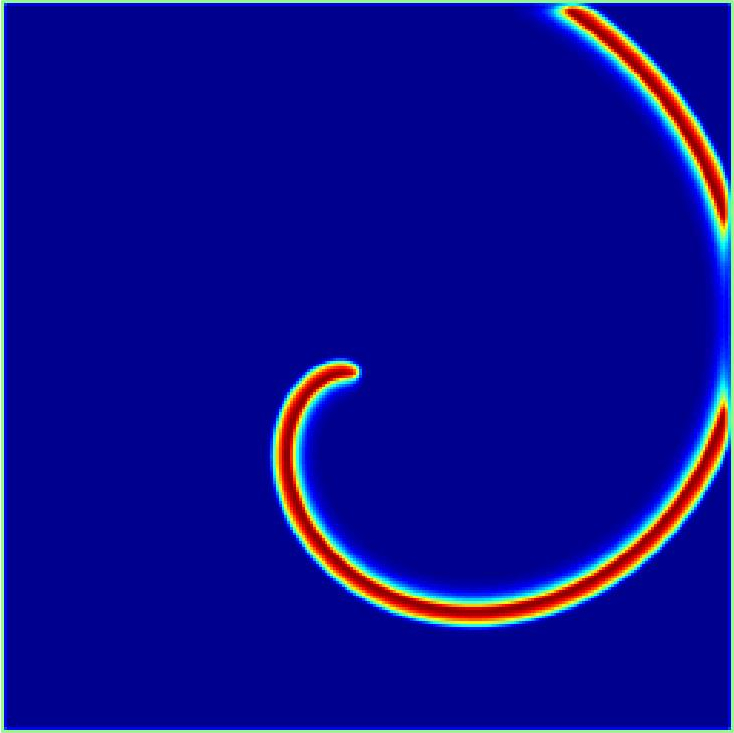
Traveling spiral wave (normal beating)
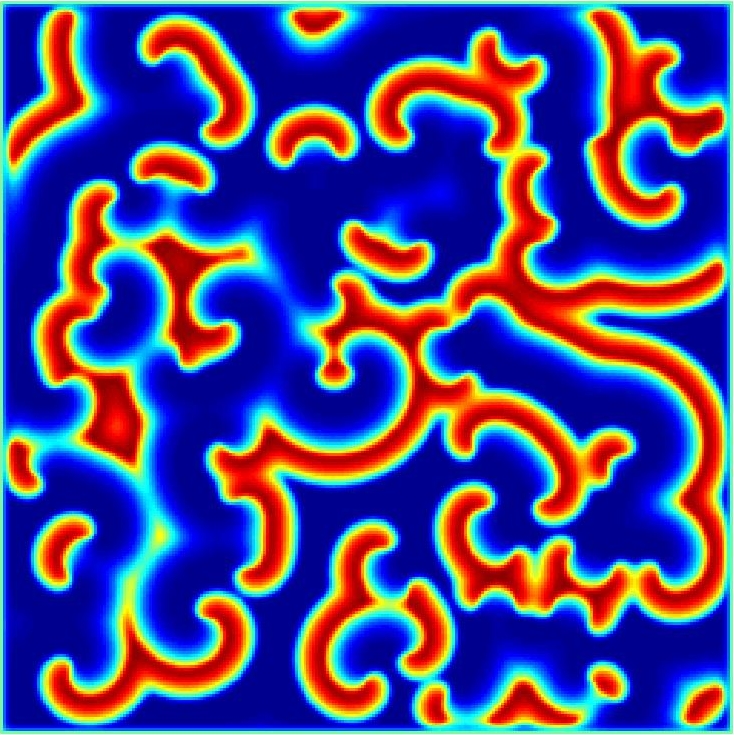
Spiral wave breakup (fibrillation)
Our research uses the tools and techniques of dynamical systems and pattern formation to study the self-sustaining fibrillatory dynamics and the mechanisms responsible for their initiation and maintenance, with the ultimate goal of developing effective and reliable defibrillation methods. Numerical simulations and experimental studies have identified fibrillation with the breakup of spiral waves of excitation in the heart tissue. However, neither approach has produced a clear picture of what the mechanism of spiral breakup is. Furthermore, it is well known that both the normal beating and fibrillation are natural behaviors even in healthy hearts. Fibrillation can be provoked and stopped by an external perturbation. However the threshold for fibrillatory dynamics is much lower in desease-ridden hearts. The transition mechanism therefore is not related to the classical linear instabilities typical of pattern-forming systems but rather of a finite-amplitude bypass scenario somewhat akin to the onset of turbulence in shear flows in fluid dynamics.
Spiral breakup in the Fitz-Hugh Nagumo model of the heart tissue:
|
|
|
|
|
Traveling spiral wave (normal beating) |
Spiral wave breakup (fibrillation) |
Go back to Home Page