

![]() |
||
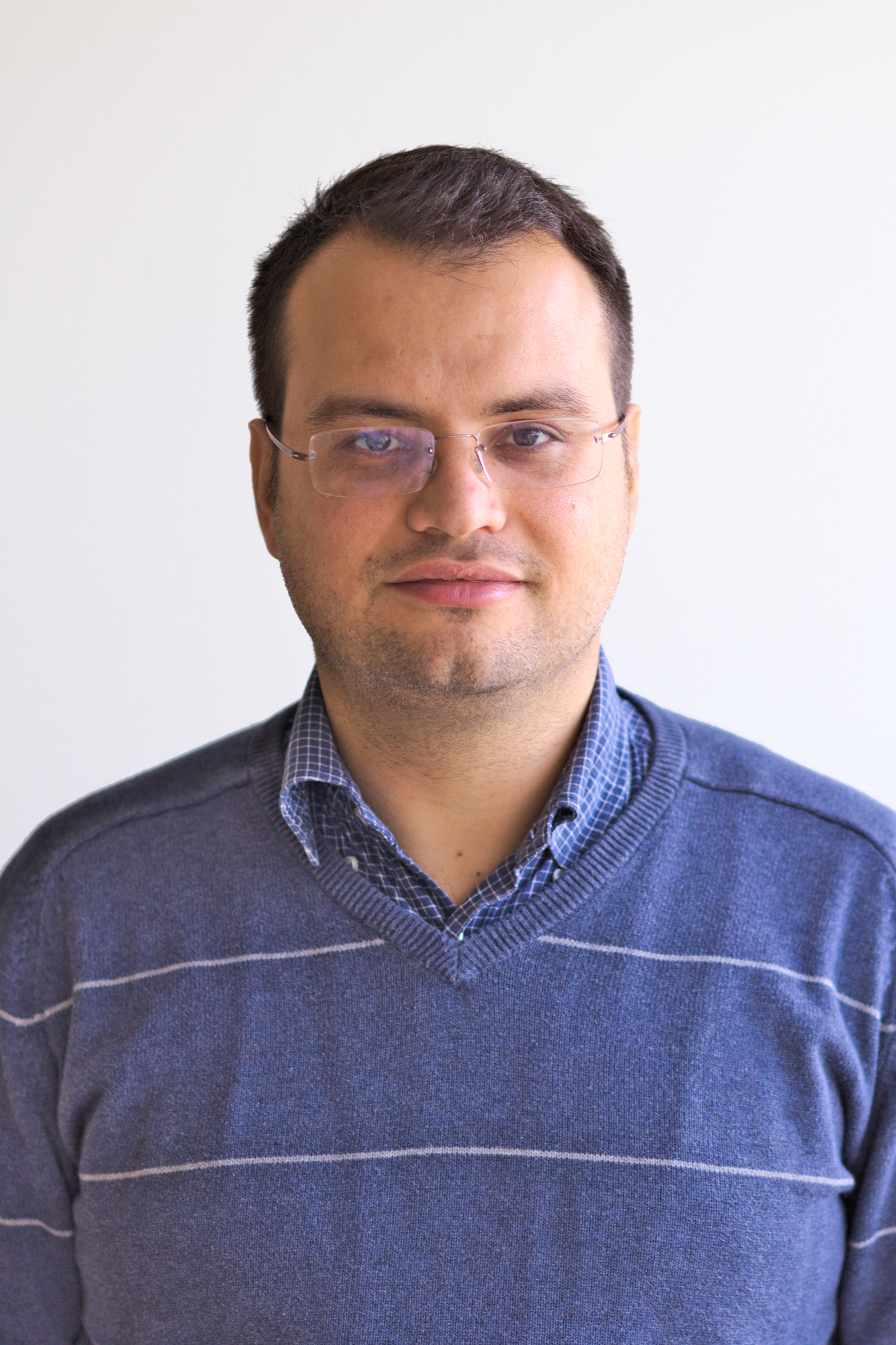
Evangelos Siminos
PhD, Georgia Tech 2009 Max Planck Institute for the Physics of Complex Systems, Nöthnitzer Str. 38, D-01187 Dresden, Germany EMail: siminos [at] gatech.edu ResearchMy research interests lie in the area of nonlinear dynamics of spatially extended systems. I focus on the application of methods of dynamical systems theory and the development of new computational techniques suitable for high-dimensional systems. Recent research projects include: Stability of Vlasov-Poisson equilibria. The Vlasov-Poisson system describes electrostatic phenomena in collisionless plasmas. The accurate and efficient computation of linear stability properties of nonlinear steady states within this framework is important both for theory and applications, for instance in the description of nonlinear saturation of processes such as stimulated Raman scattering. However, the presence of a continuum spectrum of neutral eigenmodes, associated to the transfer of energy to finer velocity scales, makes the problem hard to tackle. We have recently developed a general and efficient method to compute the dominant unstable modes of nonlinear steady states of the Vlasov-Poisson system, through a combination of spectral deformation (to "damp" the neutral spectrum) and Galerkin spectral methods (to reduce the problem to a sparse matrix eigenproblem). Read more ... Dynamics of spatially extended systems with continuous symmetries. In dynamical systems studies of turbulence the organization of the infinite-dimensional state space can be understood in terms of equilibria, periodic orbits and their stable and unstable manifolds, which serve to connect local neighborhoods. However, when traveling wave solutions are taken into account, the geometric picture is obscured by the presence of equivalent, up to a continuous symmetry transformation, trajectories. Continuous symmetry reduction (i.e. the identification of symmetry related trajectories) is required before the dynamical systems approach can then be successfully applied. Read more on: (a) The state space geometry of the Kuramoto-Sivashinsky system, a one-dimensional "toy-model" for turbulence, (b) Continuous symmetry reduction in high-dimensional flows, (c) How symmetry reduction might be applied in the Kuramoto-Sivashinsky system (my thesis, 6.5MB). Relativistic solitary waves in plasmas as connecting orbits. The current trend in the field of laser-plasma interaction, is to use short, high-intensity laser pulses to accelerate particles in much higher energies than possible with conventional accelerators of comparable size. Short laser pulses are hard to produce and control and an open question is whether longer pulses could be utilized for the same purpose of particle acceleration. A first step in this direction is to connect the problem to the existence of solitary waves in a fluid-plasma electromagnetic model. In turn, this problem can be reduced to that of finding homoclinic and heteroclinic connections of a Hamiltonian system of ordinary differential equations. Then, dynamical systems theory allows a systematic determination and classification of solitary wave solutions. We are currently working on the problem of excitation of such solutions through laser-matter interaction and their stability in a kinetic framework, in order to determine whether the solitary waves could transfer energy to the particles through wavebreaking or parametric instabilities. Read more ... LinksCenter for Nonlinear Science - CNS people - ChaosBook.org last updated 2011-07-29 |
||